Pronoun
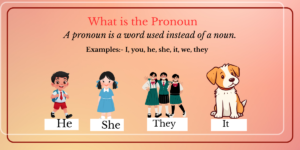
A pronoun is a word that replaces a noun (a person, place, thing, or idea) in a sentence to avoid repetition. Pronouns help make sentences shorter and less repetitive.
Example:
- Sana is my friend. She likes chocolate.
Here, she replaces Sana
Types of Pronouns with Examples
a) Personal Pronouns
Refer to a specific person or thing. They can be subjective or objective.
- Subjective: I, you, he, she, it, we, they
- Objective: me, you, him, her, it, us, them
Examples:
- Subjective: She is reading a book.
- Objective: I saw him at the park.
b) Possessive Pronouns
A possessive pronoun shows ownership or possession. It replaces a noun to indicate that something belongs to someone.
- Examples: mine, yours, his, hers, its, ours, theirs
In sentences:
- That book is mine.
- The car outside is hers.
c) Reflexive Pronouns
A reflexive pronoun is a pronoun that refers back to the subject of the sentence and ends in -self (singular) or -selves (plural). It is used when the subject and the object are the same.
Examples:
-
Singular: myself, yourself, himself, herself, itself
-
Plural: ourselves, yourselves, themselves
In sentences:
-
I made myself a sandwich
- They prepared themselves for the test.
d) Demonstrative Pronouns
A demonstrative pronoun is a pronoun that replaces a noun and points to a specific person, thing, or idea.
- Examples: this, that, these, those
In sentences:
- This is my favorite song.
- Those are beautiful flowers.
e) Interrogative Pronouns
An interrogative pronoun is used to ask questions. It replaces the noun we are asking about.
- Examples: who, whom, whose, which, what
In sentences:
- Who is coming to the party?
- Which is your bag?
f) Relative Pronouns
A relative pronoun is a pronoun that introduces a relative clause (a clause that gives more information about a noun). It connects the clause to the noun it describes.
- Examples: who, whom, whose, which, that
In sentences:
- The man who called you is my uncle.
- This is the book that I borrowed.
g) Indefinite Pronouns
An indefinite pronoun refers to non-specific persons, things, or amounts. Unlike other pronouns, it doesn’t point to a definite noun.
- Examples: anyone, everyone, someone, nobody, each, few, many, all, some
In sentences:
- Everyone enjoyed the party.
- Few dare to try.
h) Reciprocal Pronouns
A reciprocal pronoun is used when two or more people are acting on each other. It shows mutual action or relationship.
- Examples: each other, one another
In sentences:
- They love each other.
- The students helped one another with homework.
i) Intensive Pronouns
Pronouns that emphasize the subject of a sentence. Not necessary for the sentence to make sense.
- Examples: myself, yourself, himself, herself, itself, ourselves, yourselves, themselves
In sentences:
- I myself completed the project.
- The CEO himself attended the meeting.
FAQ:-
What are the types of pronouns?
- Personal Pronouns
- Possessive Pronouns
- Reflexive Pronouns
- Demonstrative Pronouns
- Interrogative Pronouns
- Relative Pronouns
- Indefinite Pronouns
- Reciprocal Pronouns
- Intensive Pronouns
Can pronouns replace any noun?
Yes, it can replace people, animals, objects, or ideas.
Example:
- The dog is cute. It is friendly.
What is a demonstrative pronoun?
A pronoun used to point out a specific thing.
Examples:
- This is my pen.
- Those are beautiful flowers.
What is an indefinite pronoun?
A pronoun that refers to unspecified people or things.
Examples:
- Everyone is happy.
- Nobody knows the answer.
Can pronouns refer to ideas or objects?
Yes. Pronouns are not only for people; they can refer to animals, objects, or ideas.
Examples:
- Love is important. It makes life beautiful.
- The car is new. It runs smoothly.
What is an interrogative pronoun?
Used to ask questions.
Examples:
- Who is coming to the party?
- Which is your bag?
What is a reciprocal pronoun?
Shows a mutual action.
Examples:
- They love each other.
- The students helped one another.
Read More:-