Contents
Future Continuous Tense Examples
Definition:
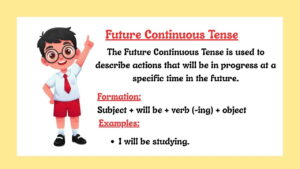
The Future Continuous Tense is used to describe actions that will be in progress at a specific time in the future. It focuses on the duration of the action, not just the fact that it will happen.
Uses of Future Continuous Tense
✅ a) Action in progress at a specific future time
- At 10 p.m., I will be sleeping.
✅ b) Planned or expected future events
- She will be meeting the principal tomorrow.
✅ c) Polite questions about someone’s plans
- Will you be using the laptop tonight?
✅ d) Two actions happening at the same time in the future
- While you are studying, I will be cooking.
Hindi meaning:
हिंदी वाक्यों के अंत में अक्सर ऐसे शब्द आते हैं:
-
रहा होगा / रही होगी / रहे होंगे
Sentence Types:
- Affirmative Sentence
- Negative Sentence
- Interrogative Sentence
- Negative Interrogative Sentence
- “WH family” Interrogative Sentence
1. Affirmative (सकारात्मक वाक्य)
Formula
Subject + will be + verb (-ing) + object
Examples:
- I will be studying.
👉 मैं पढ़ रहा होगा। - She will be cooking food.
👉 वह खाना बना रही होगी। - They will be playing cricket.
👉 वे क्रिकेट खेल रहे होंगे।
2. Negative Sentences (नकारात्मक वाक्य)
Formula:
Subject + will not (won’t) be + verb (-ing) + object
Examples:
- I will not be studying.
👉 मैं पढ़ नहीं रहा होगा। - She will not be dancing.
👉 वह नाच नहीं रही होगी। - They won’t be watching TV.
👉 वे टीवी नहीं देख रहे होंगे।
3. Interrogative Sentences( प्रश्नवाचक वाक्य)
Formula:
Will + subject + be + verb (-ing) + object?
Examples:
- Will you be studying?
👉 क्या तुम पढ़ रहे होंगे? - Will she be singing?
👉 क्या वह गा रही होगी? - Will they be traveling tomorrow?
👉 क्या वे कल यात्रा कर रहे होंगे!
4. Negative–Interrogative (नकारात्मक प्रश्नवाचक)
Formula (English):
Will + subject + not be + verb (-ing) + object?
OR
Won’t + subject + be + verb (-ing) + object?
Examples:
- Won’t you be studying?
👉 क्या तुम पढ़ नहीं रहे होंगे? - Will she not be working?
👉 क्या वह काम नहीं कर रही होगी? - Won’t they be waiting for us?
👉 क्या वे हमारा इंतज़ार नहीं कर रहे होंगे?
FAQ – Future Continuous Tense
1. What is the Future Continuous Tense?
Answer:
The Future Continuous Tense is used to describe an action that will be in progress at a particular time in the future.
Example:
- I will be studying at 8 p.m.
Q.2 Which helping verb is used?
Answer:
The helping verb used is “will be.”
Q.3 Is the main verb always in –ing form?
Answer:
Yes. The main verb must always be in the –ing form.
Example:
She will be writing a letter.
Q4. Can “shall” be used in the Future Continuous Tense?
Answer: In modern English, “will” is used with all subjects.
“Shall” is rarely used.
Q5. How do we make negative sentences?
Answer
Structure:
Subject + will not be + verb (–ing)
Example:
- He will not be coming today.
Q6. How do we form interrogative sentences?
Answer:
Structure:
Will + subject + be + verb (–ing)?
Example:
- Will you be waiting for me?
Q7. What is a negative interrogative sentence?
Answer:
It is a question that is both negative and interrogative, typically using ‘won’t’.
Example:
- Won’t she be attending the meeting?
Q8. Can the Future Continuous Tense be used for daily habits?
Answer:
No. It is not used for habitual or regular actions.
❌ I will be going to school every day.
✅ I will go to school every day.
Q9. What time expressions are commonly used?
Answer:
- at this time tomorrow
- at 5 p.m.
- tomorrow evening
- next week
Example:
- This time tomorrow, we will be traveling.
Q10. When is the Future Continuous Tense commonly used?
Answer:
- To show an action in progress in the future
- To describe planned or expected future activities
- To sound polite or less direct
Q11. Is the Future Continuous Tense important for exams?
Answer:
Yes. It is commonly asked in:
- sentence formation
- tense identification
- grammar corrections
Conclusion
The Future Continuous Tense is an important part of English grammar that helps us describe actions that will be in progress at a specific time in the future. Formed with “will be + verb-ing,” this tense makes communication clearer when talking about plans, ongoing activities, and expected events. By understanding how and when to use the Future Continuous Tense, learners can improve both their spoken and written English and express future situations more naturally and accurately.
Adjective definition and examples
Adverb Definition and Examples
Preposition Definition and Examples
Present Indefinite Tense in Hindi
I hope you enjoy this article, ‘Future Continuous Tense Examples.’
Some really wonderful information, Glad I found this. “Prayer indeed is good, but while calling on the gods a man should himself lend a hand.” by Hippocrates.