Let’s start with the part of speech in English.
1. Noun (संज्ञा)
Definition:
A noun is the name of a person, place, thing, animal, or idea.
संज्ञा किसी व्यक्ति, स्थान, वस्तु, प्राणी या भाव के नाम को कहते हैं।
Types of Noun:
- Proper Noun (व्यक्तिवाचक संज्ञा)Specific name Rohit, India, Delhi
- Common Noun (जातिवाचक संज्ञा)General name Girl, City, River
- Collective Noun (समूहवाचक संज्ञा)Group name Team, Class, Army
- Material Noun (द्रव्यवाचक संज्ञा)Material/substance Gold, Water, Milk
- Abstract Noun (भाववाचक संज्ञा)Quality, feeling, idea Honesty, Love, Freedom
Example:
- Rohit is a boy.रोहित एक लड़का है।
2. Pronoun (सर्वनाम)
Definition:
A pronoun is a word used in place of a noun.
सर्वनाम संज्ञा के स्थान पर प्रयोग किया जाता है।
Types:
- Personal Pronoun – I, We, You, He, She, It, They
- Possessive Pronoun – Mine, Yours, His
- Reflexive Pronoun – Myself, Himself
- Demonstrative Pronoun – This, That
- Interrogative Pronoun – Who, What
- Relative Pronoun – Who, Which, That
Example:
Rita is my sister. She is a teacher.
रीता मेरी बहन है। वह अध्यापिका है।
3. Verb (क्रिया)
Definition:
A verb shows an action, state, or condition.
क्रिया काम या अवस्था को दर्शाती है।
Types:
- Main Verb – Eat, Go, Play
- Helping Verb – Is, Am, Are, Was, Have, Do
- Transitive Verb – Needs object
- Example: He reads a book.
- Intransitive Verb – No object
- Example: The baby sleeps.
Example:
- She writes a letter.वह पत्र लिखती है।
4. Adjective (विशेषण)
Definition:
An adjective describes a noun or pronoun.
विशेषण संज्ञा या सर्वनाम की विशेषता बताता है।
Types:
- Quality – Good, Bad
- Quantity – Some, Much
- Number – One, Two
- Demonstrative – This, That
- Possessive – My, Your
Example:
- She has a beautiful dress.उसके पास सुंदर कपड़ा है।
5. Adverb (क्रिया–विशेषण)
Definition:
An adverb describes a verb, adjective, or another adverb.
क्रिया–विशेषण क्रिया की विशेषता बताता है।
Types:
- Manner – Slowly, Quickly
- Time – Now, Today
- Place – Here, There
- Frequency – Always, Often
- Degree – Very, Too
Example:
- He runs fast.वह तेज़ दौड़ता है।
6. Preposition (संबंधबोधक)
Definition:
A preposition shows the relationship between a noun/pronoun and another word.
संबंधबोधक शब्दों के बीच संबंध बताता है।
Common Prepositions:
In, On, At, Under, Over, Between, Behind
Example:
- The book is on the table.किताब मेज़ पर है।
7. Conjunction (संयोजक)
Definition:
A conjunction joins words, phrases, or sentences.
संयोजक शब्दों या वाक्यों को जोड़ता है।
Types:
- Coordinating – And, But, Or
- Subordinating – Because, Although
- Correlative – Either…or, Neither…nor
Example:
- I like tea and coffee.मुझे चाय और कॉफी पसंद है।
8. Interjection (विस्मयादिबोधक)
Definition:
An interjection expresses sudden feelings or emotions.
विस्मयादिबोधक भाव व्यक्त करता है।
Examples:
Oh!, Wow!, Alas!, Hurrah!
- Wow! You did great.वाह! तुमने बहुत अच्छा किया।
9. Article (उपपद)
Definition:
Articles are used before nouns.
Article संज्ञा से पहले आता है।
Types:
- Indefinite – A, An
- Definite – The
Example:
- I saw a dog.
- The sun rises in the east.
FAQ: Part of speech in English
1. What is a part of speech?
A part of speech is a category that shows how a word functions in a sentence (for example: noun, verb, adjective).
2. How many parts of speech are there in English?
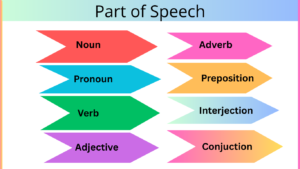
Traditionally, there are 8 parts of speech:
-
Noun
-
Pronoun
-
Verb
-
Adjective
-
Adverb
-
Preposition
-
Conjunction
-
Interjection
(Some grammars also include articles/determiners.)
3. Can one word belong to more than one part of speech?
Yes. Many English words can function as different parts of speech depending on context.
-
I have a question. (noun)
-
I question the answer. (verb)
4. What is a noun?
A noun names a person, place, thing, or idea.
-
book, teacher, freedom
5. What is a verb?
A verb shows an action or a state of being.
-
run, think, is
6. What is an adjective?
An adjective describes or modifies a noun.
-
interesting question
7. What is an adverb?
An adverb modifies a verb, adjective, or another adverb.
-
answer quickly
8. Can a noun act like an adjective?
Yes. A noun can modify another noun.
I hope you like the part of speech in English