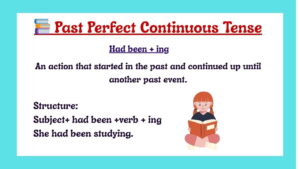
Past Perfect Continuous Tense
This tense shows:
An action that began in the past and continued for some time before another past action occurred.
हिंदी में पहचान:
जिस वाक्य के अंत में —
रहा था / रही थी / रहे थे
और वाक्य में समय + से दिया हो,
वह Past Perfect Continuous Tense होता है।
Formation (Structure)
✅ Affirmative Sentences (सकारात्मक वाक्य)
Structure:
Subject + had been + Verb (1st form + ing) + time
Examples:
- I had been reading for two hours.
➜ मैं दो घंटे से पढ़ रहा था। - She had been cooking since morning.
➜ वह सुबह से खाना बना रही थी। - They had been playing for a long time.
➜ वे काफी देर से खेल रहे थे।
2. Negative Sentences (नकारात्मक वाक्य)
Structure:
Subject + had not been + Verb (ing) + time
Short form: had not = hadn’t
Examples:
- I had not been sleeping well.
➜ मैं अच्छी तरह से नहीं सो रहा था। - He hadn’t been working there long.
➜ वह वहाँ ज्यादा समय से काम नहीं कर रहा था।
3. Interrogative Sentences (प्रश्नवाचक वाक्य)
Structure:
Had + subject + been + Verb (ing) + time?
Examples:
- Had you been waiting for me?
➜ क्या तुम मेरा इंतज़ार कर रहे थे? - Had she been studying since evening?
➜ क्या वह शाम से पढ़ रही थी?
4. Negative Interrogative Sentences
Structure:
Had + subject + not been + Verb (ing)?
Example:
- Had he not been working hard?
➜ क्या वह मेहनत नहीं कर रहा था?
🔹 Time Words Often Use
FOR = Period of Time (समय की अवधि)
👉 How long? (कितने समय तक)
We use FOR when the time is a duration.
Examples of duration:
- for 2 hours
- for 5 days
- for a long time
- for 10 minutes
- for many years
Sentences:
✔ I have been studying for two hours.
➜ मैं दो घंटे से पढ़ रहा हूँ।
✔ She had been waiting for a long time.
➜ वह काफी समय से इंतज़ार कर रही थी।
✔ They lived there for five years.
➜ वे पाँच साल तक वहाँ रहे।
🔹 SINCE = Point of Time (समय की शुरुआत)
👉 Since when? (कब से)
We use SINCE when the time shows the starting point.
Examples of starting point:
- since morning
- since 5 PM
- since Monday
- since 2020
- since childhood
Sentences:
✔ I have been studying since morning.
➜ मैं सुबह से पढ़ रहा हूँ।
✔ She had been crying since the evening.
➜ वह शाम से रो रही थी।
✔ He has lived here since 2015.
➜ वह 2015 से यहाँ रह रहा है।
Past Perfect Continuous Tense – FAQ
1. What is the Past Perfect Continuous Tense?
It shows an action that was continuing for some time in the past before another past action happened.
2. What is the formation (rule)?
Structure:
Subject + had been + Verb-ing + time reference
✔ She had been studying.
✔ We had been waiting.
3. When do we use it?
We use it when:
- An action continued for a duration
- It happened before another past event
✔ I had been sleeping for 3 hours before you called.
4. What is the difference between “since” and “for”?
| Word | Use | Example |
| Since | Starting point in time | since morning, since 5 PM |
| For | Period of time | for 2 hours, for a long time |
✔ She had been crying since morning.
✔ She had been crying for two hours.
5. Can we use it without time words?
Usually it is used with a time duration, but sometimes time is understood.
✔ He was tired because he had been running.
6. How is it different from Past Continuous?
| Past Continuous | Past Perfect Continuous |
| Action was happening at a time in the past | Action was happening for some time before another past action |
| I was studying. | I had been studying for 2 hours before dinner. |
7. What is the negative form?
Subject + had not been + verb-ing
✔ She had not been feeling well.
8. How do we make questions?
Had + subject + been + verb-ing?
✔ Had you been waiting long?
9. Is “had been” used for all subjects?
Yes ✅
I / You / He / She / They / We → had been
10. Common mistakes students make
❌ I had been study.
✔ I had been studying.
Always use verb + ing.
Conclusion
The Past Perfect Continuous Tense is used to describe an action that started in the past and continued for a period of time before another past event occurred. This tense primarily focuses on the duration of the action, which is why time expressions like ‘for’ and ‘since’ are commonly used with it.
Its basic structure is “had been + verb + ing”, and it remains the same for all subjects.
Read More:-
I hope you like this article.
Fantastic post however , I was wanting to know if you could write a litte more on this topic? I’d be very grateful if you could elaborate a little bit further. Bless you!
I am always thought about this, appreciate it for posting.